
Labor Efficiency to Token Efficiency
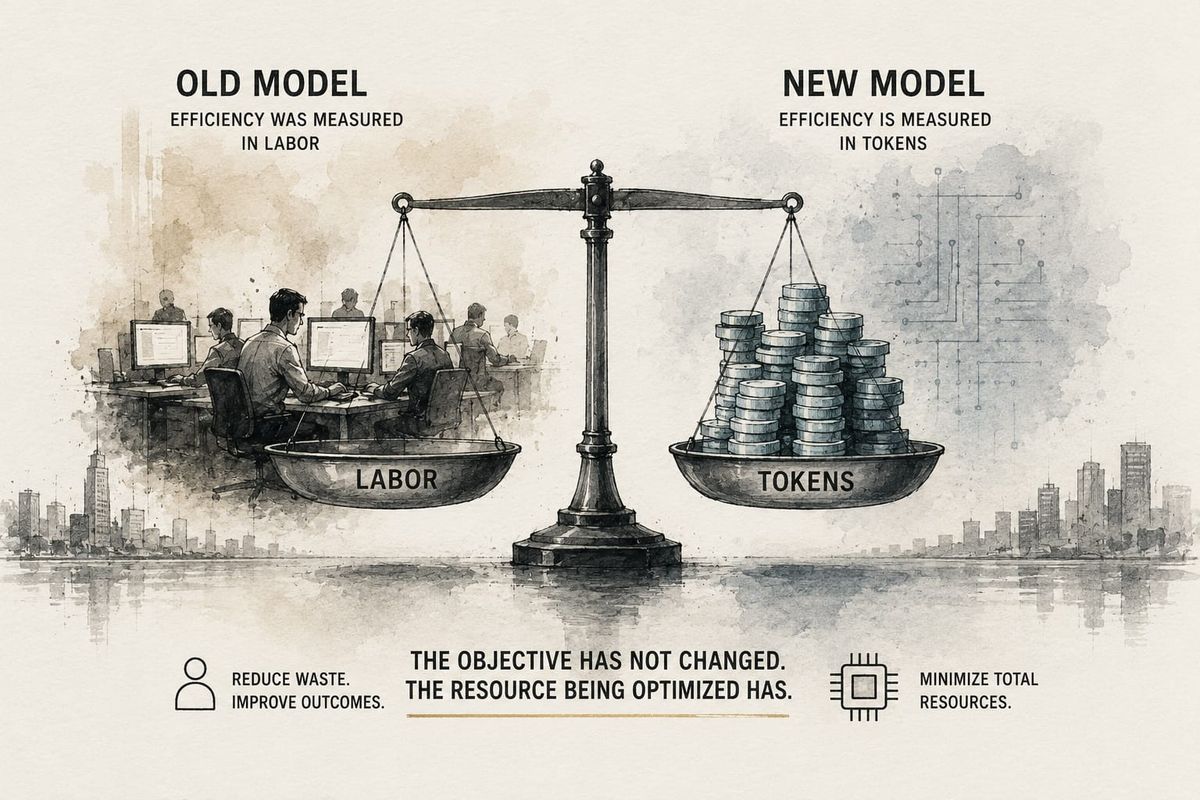
Efficiency used to be measured through labor. Organizations invested in software, automation, and process improvements to reduce the amount of human effort required to produce an outcome. The objective was straightforward: achieve the same result with fewer resources dedicated to execution.
AI introduces a new resource that must be managed: tokens. Every interaction with an AI system consumes tokens, and those tokens have a cost. As AI moves from experimentation into daily operations, organizations are discovering that efficiency is no longer measured solely by labor utilization. It is increasingly measured by token utilization as well.
This creates a different economic model. An organization can no longer assume that reducing labor automatically improves efficiency. If a process that once consumed labor is replaced by a process that consumes large volumes of tokens, the expense has not disappeared. It has moved. The question is no longer whether work is performed by people or AI. The question is how many resources are required to produce the outcome.
This helps explain some of the workforce reductions occurring across the industry. The common narrative is that AI is replacing expertise. In many cases, the expertise is still required. Organizations still need decisions, analysis, investigations, and judgment. What has changed is the mechanism used to deliver that expertise. Companies are increasingly evaluating whether they can justify paying for both the human execution of work and the token consumption required to automate it.
The next stage of efficiency will be measured differently. Labor efficiency asked how much human effort was required to achieve a result. Token efficiency asks how many tokens are required to achieve the same result. Organizations that optimize only labor costs will miss part of the equation. Organizations that optimize only token costs will miss it as well. The objective is to minimize the total resources required to produce an outcome.
This shift is still in its early stages, but the pattern is becoming visible. Organizations are beginning to treat tokens the way they once treated labor hours. They are measuring consumption, evaluating utilization, and looking for opportunities to eliminate waste. As AI adoption continues, token efficiency may become as important to operational planning as labor efficiency has been for generations.
The organizations that gain the greatest advantage from AI will not necessarily be those that use the most AI. They will be those that learn how to produce the best outcomes with the fewest tokens. That is the same economic principle that has driven efficiency programs for years. The resource being optimized has simply changed.
Security Operations: An Example of Token Efficiency
Security operations may become one of the first large-scale tests of token efficiency.
A Security Operations Center consumes two resources in significant quantities: data and labor. Large volumes of telemetry are collected, analyzed, and reviewed so that analysts can determine which issues require action. The process appears to be about technology because the inputs are technical. In reality, the core function of a SOC is decision making. The output is not an alert, a dashboard, or a report. The output is a decision about what should happen next.
This distinction becomes important as vendors increasingly position AI as a replacement for traditional analyst workflows. The assumption is often that AI can review the data, reach conclusions, and produce outcomes with little human involvement. The challenge is that security operations is not a single decision. It is a structured process for reaching decisions. Analysts follow procedures, apply organizational knowledge, gather supporting evidence, and evaluate risk before taking action. Replacing the analyst requires more than replacing the person. It requires reproducing the process.
This is where many AI strategies will succeed or fail. Large language models can consume enormous amounts of data, but security operations has never been constrained by a lack of data. The challenge has always been determining which information matters and what action should be taken. Simply placing more telemetry into an AI system does not solve that problem. Without structure, the result is often more token consumption rather than better decisions.
The industry is beginning to move toward a different operating model. Instead of analysts performing every step of the process, AI performs the process while humans validate the outcome. This is often described as human-on-the-loop rather than human-in-the-loop. The distinction matters because the role of the analyst changes from execution to quality assurance. The objective is no longer to help the analyst work faster. The objective is to determine whether the AI reached the correct conclusion.
The success of this model depends on whether expertise has been operationalized. AI does not automatically inherit the procedures, judgment, and decision criteria that experienced analysts use. Those elements must be captured, structured, and made repeatable. Organizations that accomplish this can scale expertise through AI. Organizations that do not are simply replacing labor with token consumption while hoping the outcome remains the same.
AI’s greatest advantage in security operations is scale. A well-designed system can review more information, evaluate more conditions, and execute more consistently than a human team. That advantage only exists when the underlying process is understood. Before organizations can scale expertise, they must first define it.