
AI Can Scale Execution. It Cannot Scale Maturity.
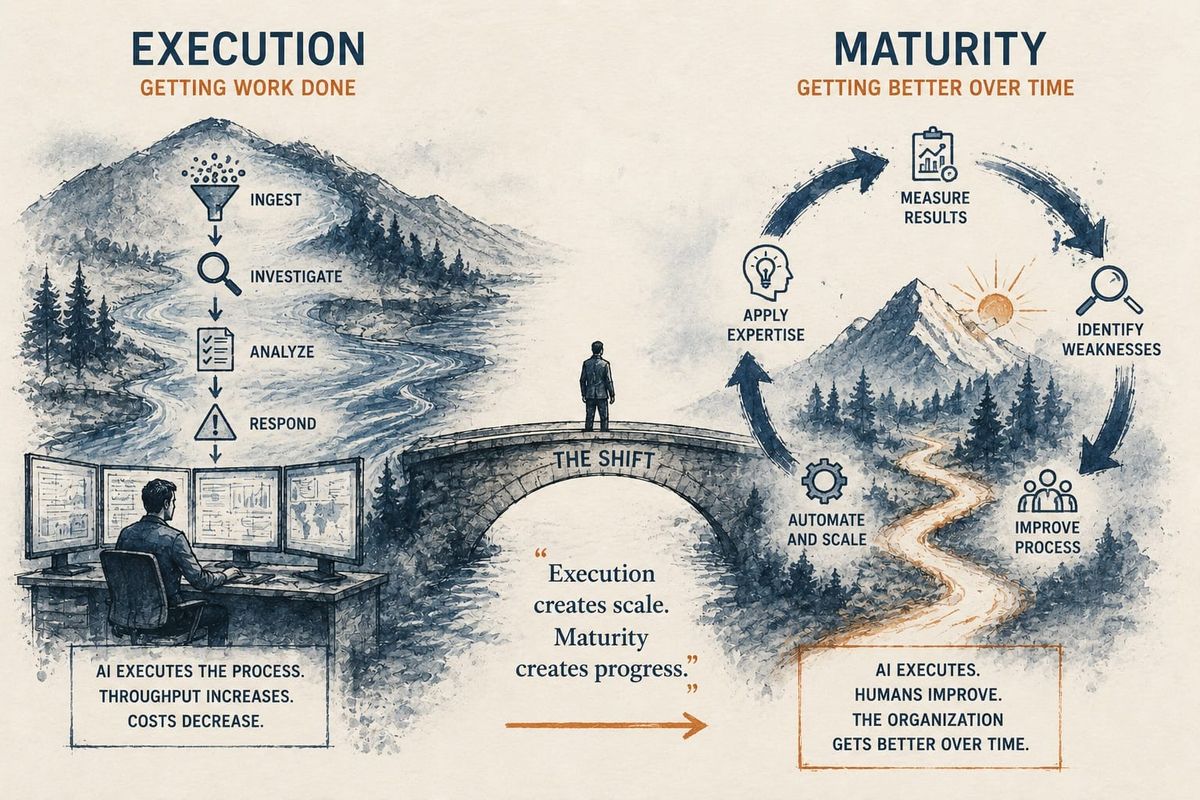
The current AI discussion is heavily focused on execution. Can AI investigate alerts? Can it write code? Can it summarize documents? Can it perform the work that was previously performed by people?
These are useful questions, but they are not the most important ones. Organizations do not become better because work gets completed. Organizations become better because they learn from the work they perform. Execution produces outcomes. Maturity produces improvement.
This distinction has existed long before AI. The Carnegie Mellon Capability Maturity Model was built around a simple observation: successful organizations do not rely on individual effort alone. They develop processes, measure results, identify weaknesses, and improve over time. The objective is not merely to perform a task. The objective is to become more capable of performing that task in the future.
Security Operations Centers provide a useful example. A SOC is often described as a collection of technologies that process telemetry and investigate alerts. That description focuses on the inputs. The actual purpose of a SOC is to make decisions. Analysts evaluate information, determine what is relevant, assess risk, and decide what action should be taken. The value is not the analysis itself. The value is the decision-making process that turns information into action.
AI is beginning to take over much of that execution. Vendors increasingly promote security operations platforms that require little human involvement. The promise is compelling. AI can review more data, evaluate more conditions, and operate continuously without the staffing constraints that have traditionally limited security operations. From an execution perspective, the argument is difficult to ignore.
The challenge is that execution and maturity are not the same thing.
An AI system can investigate an alert. It can classify an event. It can recommend a response. What it does not automatically do is improve the process used to reach those conclusions. Most AI systems execute the process they are given. If the process contains inefficiencies, those inefficiencies are repeated at scale. If the process contains weaknesses, those weaknesses are repeated at scale as well.
This creates a problem that is easy to miss during early deployments. Initial results often look impressive because throughput increases and labor requirements decrease. Organizations see more work being completed with fewer people involved. The implementation appears successful because execution has improved. What remains unclear is whether the organization itself is becoming more capable.
Human expertise has traditionally provided the feedback loop that drives maturity. Analysts discover recurring problems. Engineers create better tooling. Teams refine procedures. Over time, reasoning becomes process, and process becomes automation. The organization does not simply perform the work. It improves the way the work is performed.
Most AI systems do not naturally participate in that cycle. They are designed to execute tasks, not evaluate whether the underlying methodology should change. In many cases, AI reaches a conclusion through repeated reasoning rather than through accumulated process improvement. The result may be acceptable, but the organization has not necessarily learned anything from the outcome.
This is why the distinction between human-in-the-loop and human-on-the-loop matters. Human-in-the-loop assumes people actively participate in execution. Human-on-the-loop assumes the AI performs the execution while humans evaluate the quality of the outcome and the effectiveness of the process. The responsibility shifts from performing the work to improving the system that performs the work.
That shift may become one of the most important responsibilities in the AI era. Organizations that remove people entirely from the feedback loop risk creating systems that execute efficiently while remaining operationally stagnant. The work continues to get done, but the process itself stops evolving. Scale increases while maturity stalls.
This challenge is closely connected to the emerging concept of token efficiency. AI consumes tokens to reason through problems. Humans consume experience to improve processes. When organizations focus exclusively on replacing labor with token consumption, they often measure only the cost of execution. They fail to measure whether the organization is becoming more capable over time.
The long-term winners in AI will not be the organizations that automate the most work. They will be the organizations that preserve and strengthen the feedback loops that drive maturity. Execution creates scale. Maturity creates progress. An organization that achieves both will improve its economics, improve its quality, and continue improving long after the initial AI deployment is complete.