
Defining the Modern SIEM
Most people still think of a SIEM as a giant database. You see it in how they talk about platforms like Splunk, Sumo Logic, or Elastic. The conversation is always about storage, search speed, dashboards. But that model is outdated.
Short Intro to a Modern SIEM
A SIEM was meant to be more than a place to store data. It was meant to help you make security decisions. And that’s where the old model breaks down. As environments grew, more data did make detection better. It also made it slower, more expensive, and harder to understand what actually matters.
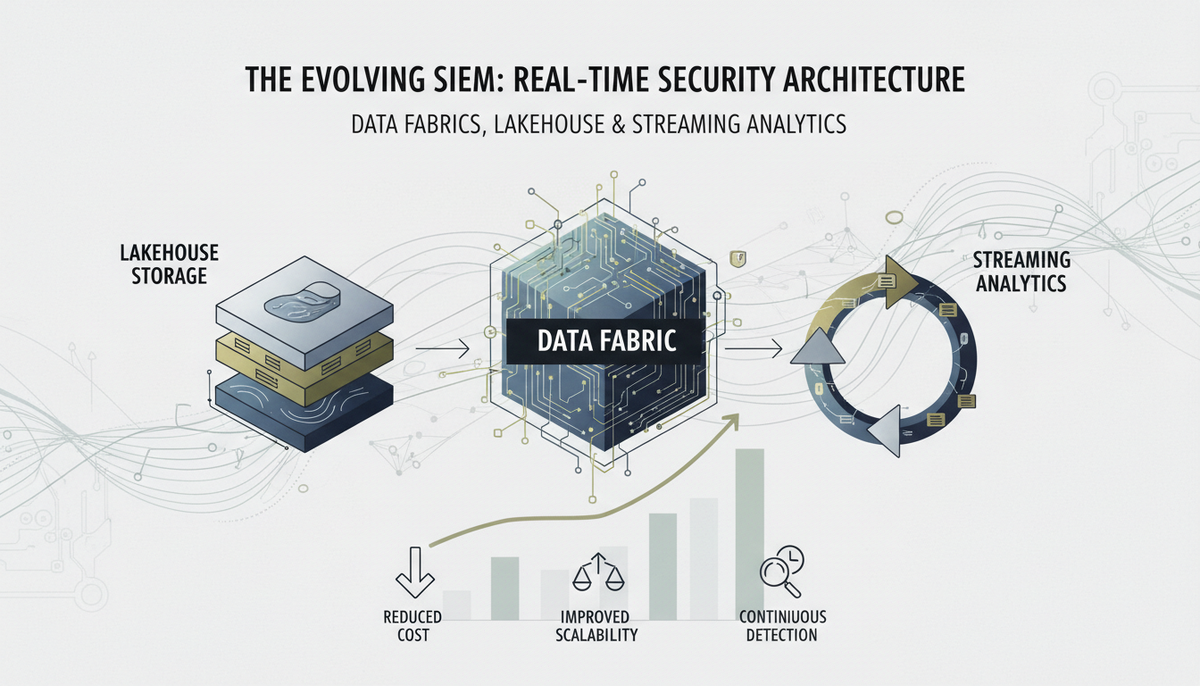
So the industry changed the architecture. Modern SIEMs are built on three things.
First, a data fabric.
This is the control layer. It transforms and enriches the data prior to storage. Fabrics also can share the data to other systems, remove unused data, and store telemetry data into less expensive storage techniques, like lakehouses.
And that is the second major capability of new SIEMs.
Storage is no longer tied to the SIEM itself. Data can be distributed for better search. In a lake house data is kept in low-cost, scalable storage in open formats. That means you can retain everything without blowing up cost, and multiple systems can use the same data.
And third, streaming analytics.
This is the biggest shift. Instead of storing data and searching it later, modern SIEMs analyze data as it arrives. This removes the search frequency altogether, making alerting immediate. Streaming can maintain context, track behavior over time, and detect issues in motion.
When you put these three together, the definition of a SIEM changes.
It’s no longer a database with rules and charts. It also positions the SIEM to be more aligned with advances in data analytics, which are being spearheaded by AI.
We can see this pattern in Fluency, CrowdStrike and SentinelOne. CrowdStrike purchased Humio for data storage and Onum for their fabric. SentinelOne bought Skylar for their storage and Observio for their fabric. Fluency Security remains the only agnostic solution with Ingext data fabric with built in lakehouses.
SIEMs continue to evolve. And newer SIEMs have distinct advantages over the older database centric designs.
This is good, but the sentence kind of like just ends. How do we transition that into the call to action? Something like, we more and understood more about modern Sims on fluencysecurity.com or something like that.