
Delivering Logic as a Service
Fluency is releasing a major architectural change designed specifically for AI-assisted operations. The architecture is intended to work with emerging systems such as Claude Co-Work, ChatGPT, Codex, and other agent-based platforms that are increasingly becoming consumers of operational knowledge. Explaining that change is not particularly easy because several independent concepts are evolving at the same time, and conversations about them often blur together.
One source of confusion is the tendency to focus on the mechanism rather than the objective. Discussions about AI-enabled platforms frequently center on APIs, MCP servers, integrations, and communication frameworks. Those technologies matter, but they describe how systems communicate. They do not explain how expertise is captured, how decisions are governed, or how operational knowledge becomes accessible to people and AI systems. Focusing exclusively on the transport layer can make fundamentally different architectural approaches appear identical when they are not.
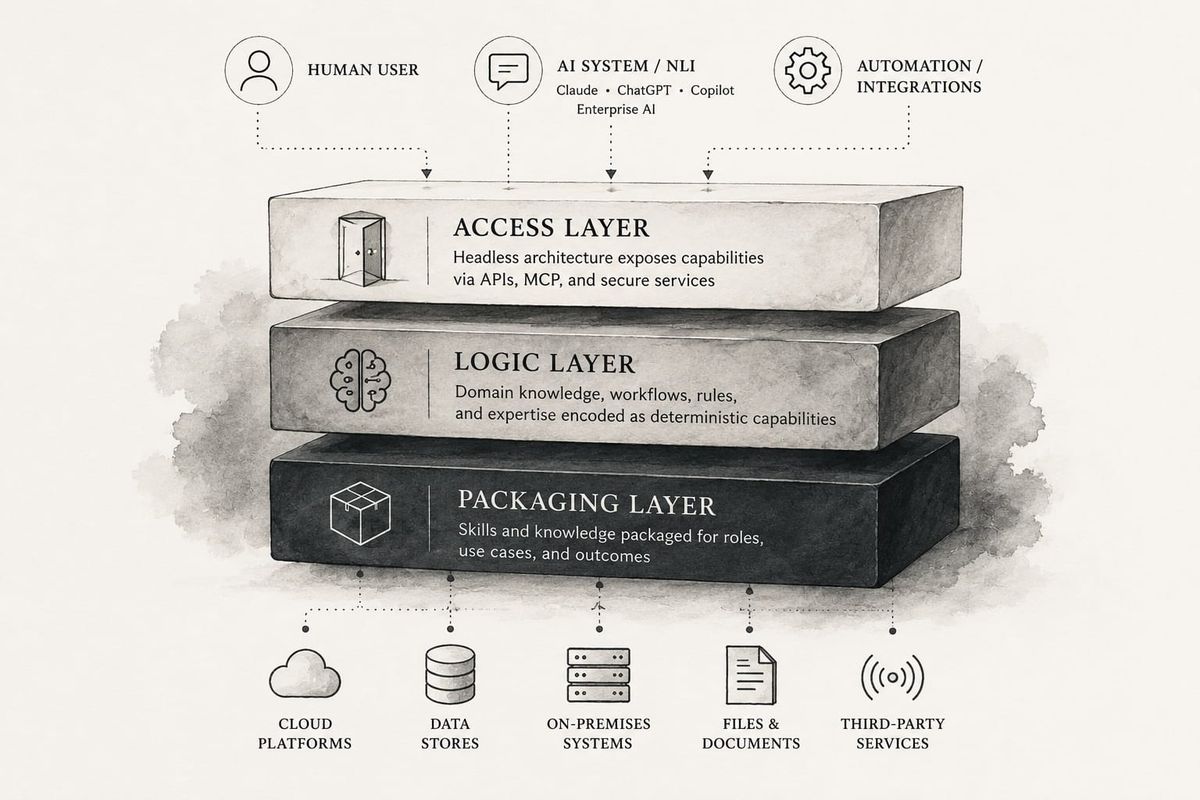
The architectural changes Fluency is introducing are easier to understand when viewed as three separate problems. The first problem is access. If capabilities are going to be consumed by people, automation platforms, and AI systems, they must be independent of a specific interface. The second problem is expertise. Access to data does not provide access to operational knowledge, investigative procedures, risk methodologies, or customer-specific practices. The third problem is delivery. Different users require different forms of expertise, and exposing everything to everyone creates complexity rather than value.
Fluency addresses these problems through three related architectural components. The Headless SIEM architecture addresses access by separating capabilities from interfaces. The Logic Layer addresses expertise by transforming domain knowledge into governed operational capabilities. Packages address delivery by organizing those capabilities around a specific role, objective, or operational need. Each component solves a different problem. Together, they define the direction of the platform and provide a framework for understanding how security operations can evolve in an AI-driven environment.
Why This Discussion Exists
AI is forcing SaaS companies to justify where their value resides.
A significant portion of the technology industry operates under the assumption that most applications are little more than interfaces sitting on top of databases. If that assumption is correct, then AI systems can interact directly with the underlying data and much of the application layer becomes unnecessary. The interface stops being the product. It becomes one possible method of accessing information.
That assumption creates an uncomfortable challenge for software vendors because databases are widely available and user interfaces are increasingly easy to generate. Neither creates a durable business on its own. The value of a successful software company must exist somewhere else.
Organizations such as ServiceNow, Salesforce, and HubSpot are responding to this challenge by focusing on the operational knowledge embedded within their platforms. Their value is not derived from storing records or rendering screens. Their value comes from the workflows, decision models, governance processes, reporting methodologies, and domain expertise that determine how work is performed. The data supports those capabilities. The data is not the capability.
This distinction is becoming more visible as AI systems become consumers of software. An AI system can retrieve records, execute searches, and interact with infrastructure. Those actions provide access to information. They do not provide access to expertise. Expertise exists in the logic that determines how information is interpreted, how decisions are made, and how actions are executed.
The industry’s movement toward headless architectures is occurring within this context. The discussion is often framed around APIs, integrations, and AI connectivity because those changes are easy to see. The more significant change is that software vendors are being forced to identify, capture, and expose the expertise that gives their platforms value. Fluency’s Logic Layer is our approach to solving that problem.
Headless Architecture
A common mistake is treating headless architecture as a simple exercise in API exposure. Under that view, a vendor can take existing backend APIs, wrap them in an access mechanism such as MCP, and claim the platform is ready for AI. That approach provides connectivity, but it does not necessarily provide the operational capability a user expected from the application.
A true headless architecture has to account for the work that the application was already performing through its interface. In many systems, the graphical interface is not merely a presentation layer. It guides the user through a process, enforces structure, and helps translate infrastructure into a usable action. A wizard is a simple example. The user experiences it as part of the interface, but the value comes from the process it represents.
Moving to headless design requires that process to exist outside the interface. The capability must be available without requiring a human to click through a screen, interpret the intended sequence, or reconstruct the missing logic from a set of raw API calls. Otherwise, the AI system receives access to infrastructure but not access to the operational behavior that made the application useful.
MCP is valuable in this model because it gives AI systems a way to reach platform capabilities. It does not define what those capabilities are, how they should behave, or what operational structure should surround them. Those decisions belong to the application architecture. Headless design is therefore not the act of exposing APIs through MCP. It is the act of making the application’s real capabilities available outside the graphical interface.
For Fluency, this distinction matters because a SIEM is not valuable simply because it stores events or exposes search functions. The value resides in the platform’s ability to perform security operations, not simply store and retrieve data. Headless architecture is the work of making those capabilities available to AI systems and other consumers without reducing the platform to a database with authenticated API calls.
The Logic Layer
Separating capabilities from the interface solves the access problem. It does not solve the expertise problem.
Organizations are rarely paying for the most common answer. They are paying for the best answer. The difference between those two concepts is domain knowledge.
Domain knowledge is the expertise that determines how work should be performed within a specific discipline. It represents the accumulated judgment of experienced practitioners and often exists because the most common approach is not the correct approach. This distinction is particularly important in security operations, where the easiest response is frequently different from the appropriate response. Organizations invest in security products and security professionals because they need that judgment applied consistently.
Large language models are highly effective at recognizing patterns and generating responses based on information they have observed previously. They are far less effective at deriving the operational expertise that distinguishes a mature process from a common one. Expertise must be defined before it can be applied.
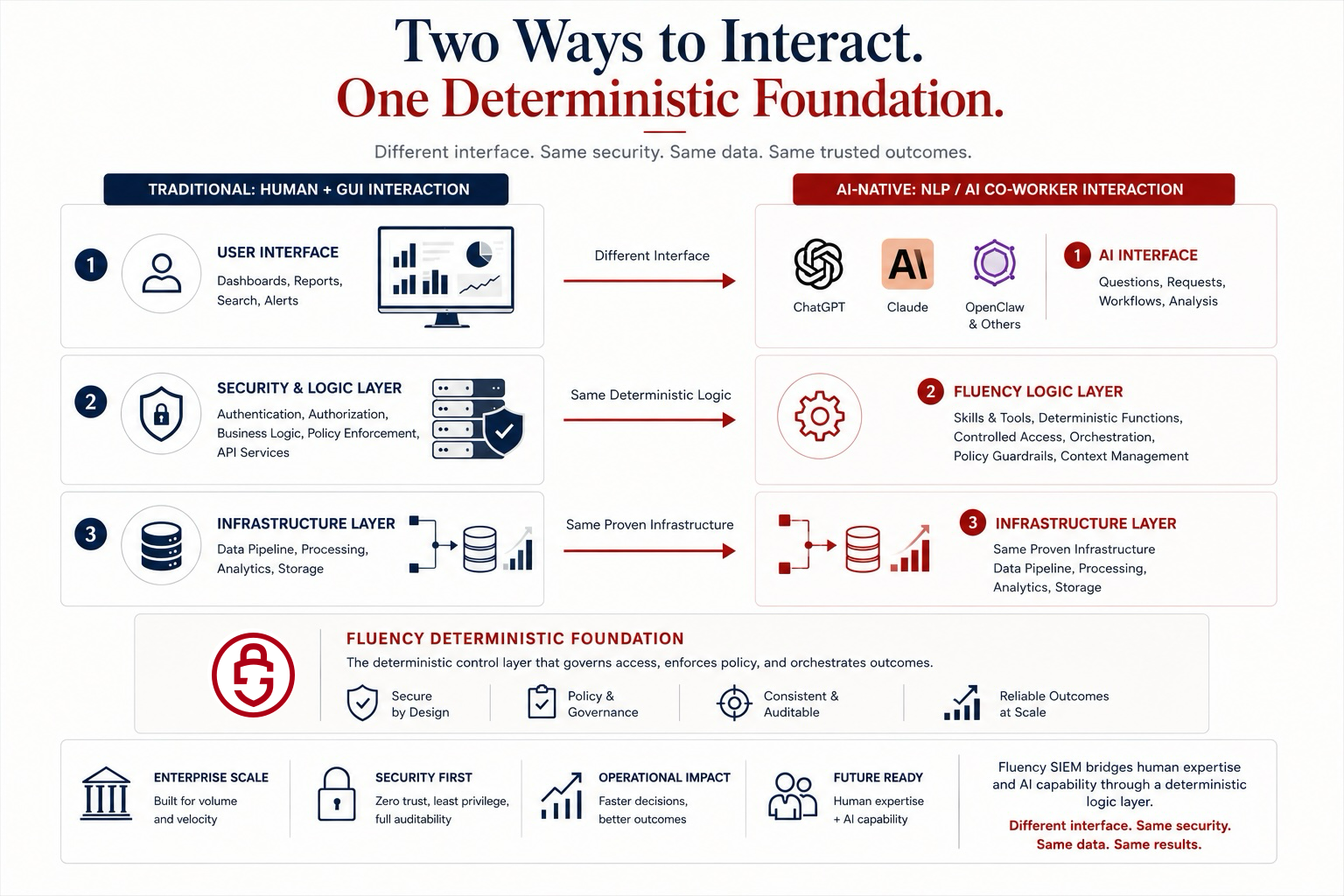
The purpose of the Logic Layer is to capture that expertise and make it available to the platform. Some of that expertise originates from Fluency. Some of it originates from the customer. In both cases, the objective is the same: transform operational knowledge into deterministic capabilities that can be executed consistently and repeatedly.
This changes how AI interacts with the platform. Rather than forcing the AI to construct a procedure from a collection of available actions, the platform provides the procedure itself. The AI’s responsibility becomes selecting and applying the appropriate capability within the appropriate context. The expertise has already been captured, validated, and encoded within the Logic Layer.
The Logic Layer exists because access to actions is not the same thing as access to expertise. AI systems can execute capabilities. The Logic Layer determines which capabilities represent the correct way to perform the work.
Delivering Expertise Through Skill Packages
Headless architecture solves the access problem. The Logic Layer solves the expertise problem. A third problem remains: how does that expertise reach the user?
Capturing domain knowledge inside the platform is only valuable if it can be applied consistently. A natural language interface such as Claude Co-Work or ChatGPT does not automatically understand how a platform should be used. It may have access to functions, tools, and capabilities, but access alone does not provide understanding. When an AI system lacks guidance, it is forced to infer intent from tool names, descriptions, and general training data. That approach may work for simple tasks, but it does not reliably reproduce the expertise that has been captured within the Logic Layer.
The challenge is not giving the AI access to functions. The challenge is teaching the AI how those functions should be used to accomplish a particular objective. Expertise exists in the relationship between capabilities, the order in which they are applied, and the criteria used to determine what should happen next. Without that context, the AI has access to actions but not to the knowledge required to use those actions effectively.
Fluency addresses this problem through skill packages. A skill package is a collection of capabilities, operational guidance, and domain knowledge organized around a specific role or objective. The package provides the context necessary for a natural language interface to understand not only what capabilities are available, but how those capabilities should be applied.
This distinction becomes important because different users require different expertise. A security analyst investigating alerts requires a different set of capabilities than an engineer responsible for platform administration. A security executive reviewing organizational risk requires different capabilities than an MSSP operator managing customer environments. The underlying platform may be identical, but the expertise delivered to each user is different because the objective is different.
Skill packages become the final bridge between the Logic Layer and the natural language interface. The Logic Layer captures expertise. Skill packages organize that expertise around a specific role or outcome. The natural language interface then uses those packages to apply the correct capabilities in the correct context. Rather than forcing the AI to infer how the platform should be used, the platform provides the expertise directly.
The Future of Security Operations
The architectural changes described throughout this paper are not unique to security. They reflect a broader shift occurring across the software industry as organizations reevaluate where value resides within their products.
For many years, software vendors benefited from controlling access to data, workflows, and interfaces. The application became the primary gateway through which users interacted with information. As AI systems become consumers of software, that model begins to change. The interface is no longer the only way to access a capability, and in many cases it is no longer the preferred way.
This shift places increasing pressure on software vendors to demonstrate value beyond storage, search, and presentation. Data can be stored in many places. Interfaces can be generated, customized, and increasingly navigated by AI systems. The differentiator becomes the expertise that determines how information is interpreted, how decisions are made, and how outcomes are produced.
Many vendors continue to build value around tightly integrated ecosystems. Those ecosystems often provide meaningful operational advantages, particularly when the underlying technologies originate from a single provider. The challenge is that tightly coupled architectures can make expertise difficult to separate from the infrastructure that delivers it. As AI becomes a primary consumer of software, organizations increasingly need capabilities that can operate across products, platforms, and data sources rather than being confined to a single ecosystem.
Fluency’s response to this challenge is the combination of Headless Architecture, the Logic Layer, and Skill Packages. Headless Architecture separates capabilities from interfaces. The Logic Layer captures and operationalizes expertise. Skill Packages deliver that expertise in a form that can be consumed effectively by a particular user, role, or objective. Together, these components transform domain knowledge into reusable operational capabilities that can be accessed by people, automation systems, and AI platforms.
The significance of this shift extends beyond convenience. Organizations are not attempting to scale data. They are attempting to scale expertise. The limiting factor in security operations is rarely access to information. The limiting factor is access to the knowledge required to interpret that information and determine the correct action. AI creates an opportunity to distribute expertise at a scale that was previously impossible, but only if that expertise has been captured and made accessible.
This is the direction Fluency believes the industry is heading. The future value of a security platform will not be determined by the amount of data it stores or the interface through which that data is viewed. It will be determined by the quality of the expertise it can deliver and the outcomes that expertise enables.