
Human "In" vs "On" the Loop
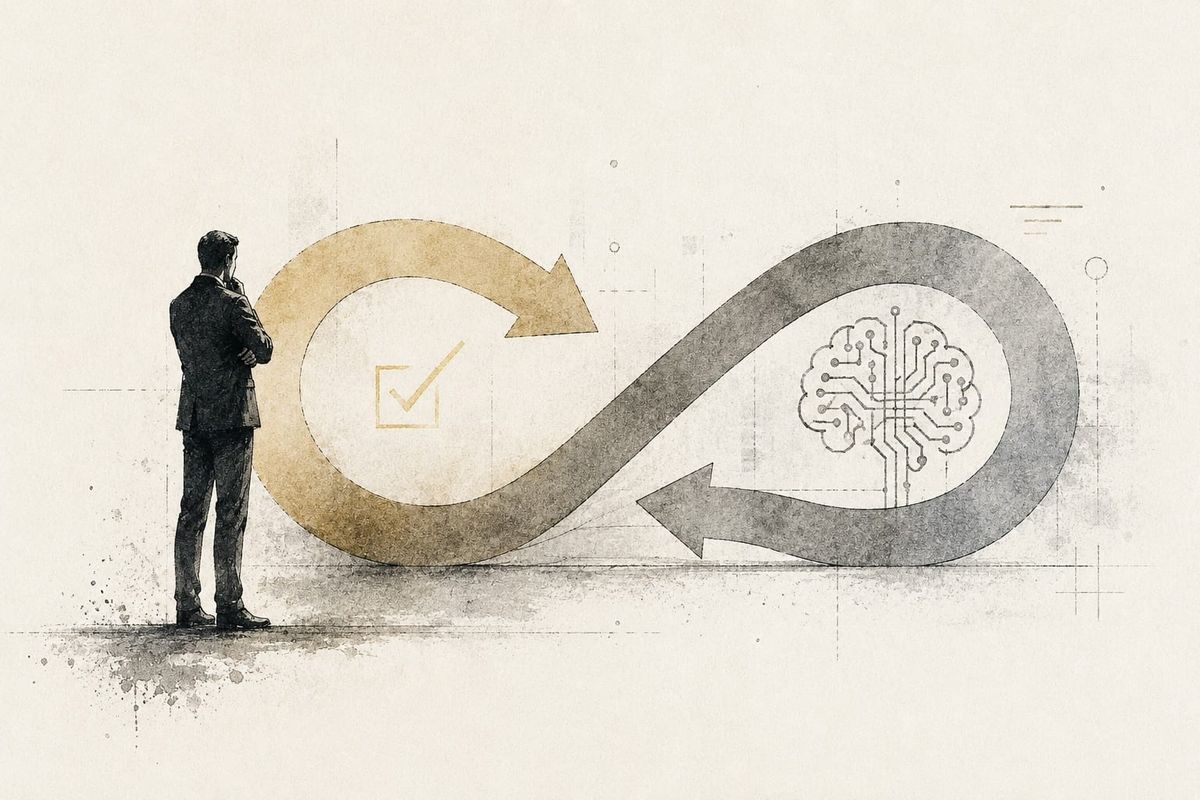
Last year we proposed that AI would not eliminate the role of the security analyst. Instead, it would redefine it. As AI became capable of performing investigations, triage, and evidence collection, analysts would spend less time executing those tasks and more time reviewing the quality of the results. The analyst would gradually evolve from being the process to becoming quality assurance for the process.
That prediction is already influencing how organizations design AI systems. As teams decide where human judgment belongs, two terms are becoming increasingly common: human-in-the-loop and human-on-the-loop. They are often treated as interchangeable, but they describe two very different operating models. The distinction is not simply where a person appears in a workflow. It defines when human expertise is applied, how quickly automation can operate, and how organizations build confidence in AI without giving up accountability.
Human in the Loop
If you’ve used an agentic development environment such as Claude CoWork or Codex, you’ve almost certainly encountered a human-in-the-loop. The AI researches a problem, modifies files, proposes changes, and then stops to ask for approval before executing the next step. The workflow cannot continue until someone reviews the recommendation and explicitly authorizes it.
That pause is what defines a human-in-the-loop. The human is not simply observing the process; they are part of the process. Every significant action requires their participation because the organization wants to validate the AI’s decision before accepting the associated risk. This approach is particularly common when teams are still developing confidence in an AI system or when the consequences of a mistake outweigh the benefits of complete automation.
The tradeoff is throughput. Every approval interrupts execution and introduces delay, making the overall speed of the workflow dependent on the availability of the people reviewing it rather than the capabilities of the AI itself.
Human on the Loop
A human-on-the-loop changes where that review occurs without removing human accountability. Instead of stopping before every important action, the AI completes its work and presents the finished result for evaluation. The person reviews the outcome, confirms that the quality meets expectations, corrects issues when necessary, and provides feedback that improves future executions.
This model is becoming increasingly common as organizations gain confidence in AI. Once the system has demonstrated that it consistently produces acceptable results, reviewing every intermediate decision provides little additional value. Human expertise shifts away from authorizing each step and toward validating the overall outcome.
The distinction is subtle, but it fundamentally changes how work is performed. The AI operates continuously at machine speed while people concentrate on quality assurance, focusing their attention on completed work and exceptional situations instead of routine decisions.
Applying the Model to Security Operations
The distinction between human-in-the-loop and human-on-the-loop becomes much more meaningful when viewed through the lens of security operations. The question is no longer whether AI can investigate an incident. The question is whether the AI should be allowed to respond before a person reviews its decision.
Before examining the implications, the tradeoff can be summarized simply.
Human in the Loop
- Human approval before action.
- Lower operational risk.
- Slower response.
- Limited by human capacity.
Human on the Loop
- AI acts before human review.
- Maximum speed and scale.
- Human validates the outcome afterward.
- Greater risk of temporary business disruption if the AI is incorrect.
Everything else is a consequence of these points.
Automated security action carries risk because security systems primarily operate by restricting capability. Blocking a user, isolating a workstation, disabling an account, quarantining email, or preventing network access all reduce the ability of someone or something to perform work. When the decision is correct, that restriction limits the damage caused by an attack. When the decision is incorrect, the restriction becomes a business problem rather than a security problem.
For that reason, the primary concern with a human-on-the-loop is not that the AI will behave unpredictably. The more practical concern is that it will temporarily remove legitimate business capability until someone notices the mistake and restores normal operation. Well-designed security automation should always make reversible changes, but even reversible actions carry a cost while they remain in effect.
That risk must be balanced against what organizations gain in return. Cyberattacks unfold in seconds, while people require time to evaluate evidence and approve actions. Allowing AI to respond immediately reduces the time available for an attacker to spread through an environment and enables the same system to make far more decisions than a human team could reasonably review in real time.
The decision between human-in-the-loop and human-on-the-loop is therefore not a technical question but a business decision. Organizations are choosing whether the benefit of responding at machine speed outweighs the possibility of temporarily disrupting legitimate business operations. The answer will differ between organizations, but the tradeoff remains the same.
Conclusion
The distinction between human-in-the-loop and human-on-the-loop may appear to be a subtle change in terminology, but it reflects a much larger shift in how organizations are thinking about AI. The discussion is no longer centered on whether AI should participate in a business process. It is centered on when human judgment should be applied.
Many people experience this transition personally when using agentic development environments such as Claude CoWork or Codex. Initially, every request for approval feels reassuring because it confirms that the AI is not acting without permission. Over time, however, those interruptions often become the bottleneck. As confidence in the quality of the AI’s work grows, many users find themselves routinely approving the same categories of actions and eventually disabling those prompts altogether.
Organizations are beginning to reach the same conclusion. Once an AI system has demonstrated that it can consistently produce acceptable results, requiring human approval before every action often provides less value than reviewing the completed outcome. Human expertise does not disappear. It moves to the point where it contributes the greatest value: validating results, correcting exceptions, and continuously improving the quality of the system.
That is why the distinction between human-in-the-loop and human-on-the-loop is becoming more common. It is not simply a change in vocabulary. It reflects a growing confidence that AI should execute routine work at machine speed while people focus on ensuring that the results remain accurate, appropriate, and aligned with business objectives.