
Gartner’s Flaws Exposed by IBM’s Collapse, Again
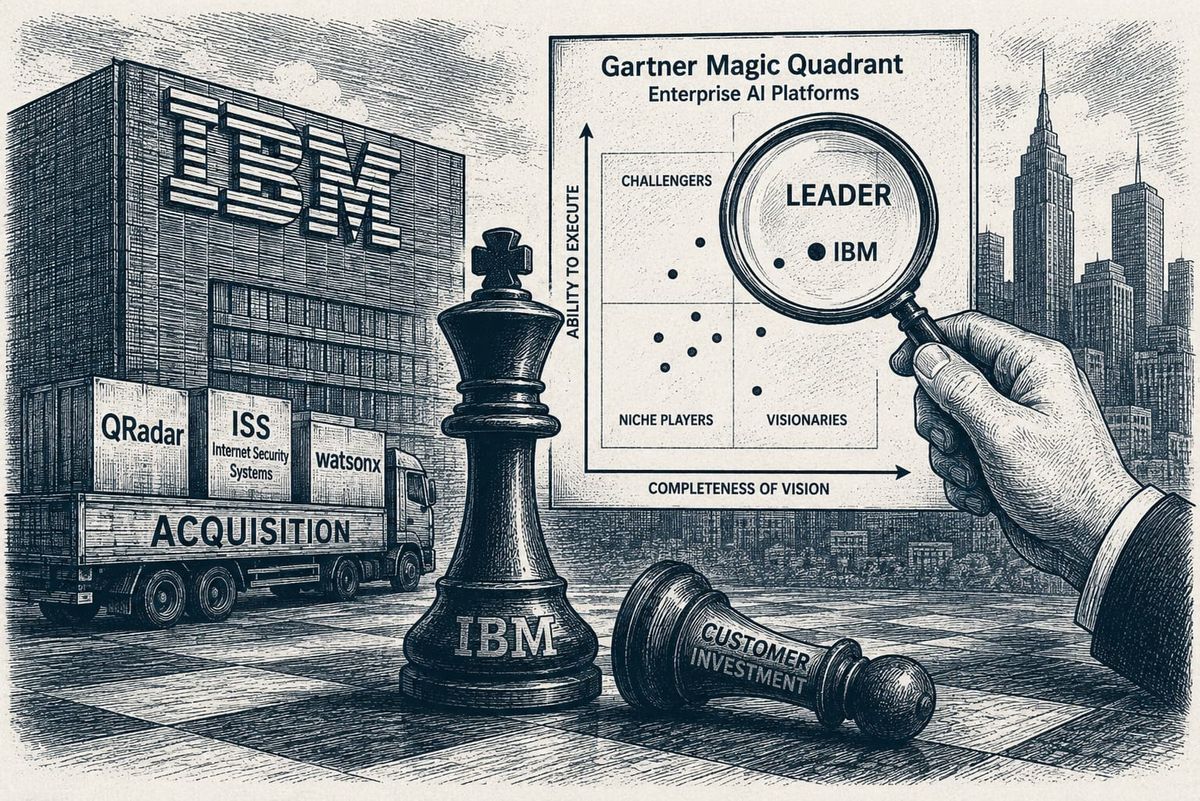
Whether Gartner calls it an endorsement or not, executive teams use the Magic Quadrant to plan technology roadmaps, build procurement shortlists, and make investments that can shape their companies for years. Many organizations purchase directly from the Leaders quadrant because they believe Gartner is exactly what it presents itself to be: an independent source of expert analysis, insulated from vendor marketing, corporate prestige, and the commercial relationships it maintains with the companies it evaluates. When Gartner designates a vendor a Leader, buyers reasonably interpret that position as evidence that the vendor represents a credible, durable direction for the market. IBM’s collapse demonstrates why that trust is dangerously misplaced.
Gartner’s confidence in IBM’s AI leadership was neither narrow nor tentative. Across 2025 and 2026, Gartner placed IBM in the Leaders quadrant eight times across seven markets spanning the enterprise AI stack. Those placements did more than recognize individual products. They validated IBM’s broader strategic narrative: that its Watson heritage, enterprise relationships, and hybrid architecture positioned it to lead companies into the AI era without requiring them to abandon existing infrastructure.
That distinction matters because Gartner’s evaluation appears to reward institutional strength and technological leadership as though they are interchangeable. IBM possesses enormous enterprise reach, a broad portfolio, and the organizational maturity expected of one of the industry’s largest technology companies. Yet while Gartner continued recognizing those strengths, the center of AI innovation shifted decisively toward frontier large language models. IBM offers Granite models and the watsonx portfolio, but it remains peripheral to a market whose technical direction has largely been established by OpenAI, Anthropic, Google, and Meta. Gartner nevertheless continued presenting IBM as an AI Leader, allowing institutional strength to stand in for leadership in the technology redefining the industry.
IBM Gartner Magic Quadrant Leader Placements, 2025–2026
| Year | Gartner Magic Quadrant Title | IBM Position |
|---|---|---|
| 2025 | Data Science and Machine Learning Platforms | Leader |
| 2025 | AI Application Development Platforms | Leader |
| 2025 | Cloud Database Management Systems | Leader |
| 2025 | Data Integration Tools | Leader |
| 2025 | Metadata Management Solutions | Leader Reportedly highest for both Ability to Execute and Completeness of Vision |
| 2026 | Data and Analytics Governance Platforms | Leader |
| 2026 | Augmented Data Quality Solutions | Leader |
| 2026 | AI Platforms for Data Science and Machine Learning | Leader |
QRadar: Another Gartner Failure
Enterprise technology is not purchased for a quarter. When a company selects a SIEM, database, cloud platform or AI architecture, it is choosing a foundation that may determine its capabilities, costs and competitive position for the next five to ten years. That is why Gartner’s Leader designation carries so much power. Buyers reasonably assume that today’s Leaders—recognized for their vision and ability to execute—are the vendors most likely to remain relevant tomorrow. The sustained dominance of companies such as Microsoft and Google reinforces that belief. A Leader is not supposed to be merely functional on the date Gartner publishes its report. It is supposed to represent a platform on which an enterprise can safely build its future.
QRadar demonstrates how badly that assumption can fail. It appeared in Gartner’s SIEM Leaders quadrant for 14 consecutive reports between 2009 and 2024, spanning almost the entirety of its life under IBM. At its height, QRadar was one of the most important SIEM platforms in the world, and thousands of organizations invested in the platform as the foundation of long-term security programs. Those investments extended far beyond licensing into the surrounding operating model, such as infrastructure, integrations, detection content and employee training. Replacing a SIEM embedded that deeply can require years of planning and millions of dollars, yet Gartner repeatedly told those buyers that QRadar was a Leader.
QRadar’s Gartner SIEM Leadership and Market Position
| Period | Ownership and Market Position | Gartner SIEM Position |
|---|---|---|
| 2009–2011 | Q1 Labs; QRadar was an increasingly important SIEM platform. | Leader Three consecutive reports |
| 2012–2016 | Early IBM ownership; QRadar became the foundation of IBM’s security portfolio. | Leader Every report |
| 2017 | QRadar was one of the industry’s strongest established SIEM products. | Leader Contemporary coverage described IBM as the best-positioned vendor in the quadrant. |
| 2018 | Major enterprise SIEM with a large installed base. | Leader |
| 2020 | Still central to IBM Security, but cloud-native SIEM competitors were emerging. | Leader Eleventh consecutive placement, including the Q1 Labs years |
| 2021 | IBM promoted QRadar’s integrated detection, investigation and response capabilities. | Leader Twelfth consecutive placement |
| 2022 | QRadar remained one of the most widely deployed enterprise SIEMs. | Leader Thirteenth consecutive placement; IBM ranked second for Ability to Execute |
| May 2024 | IBM was preparing to retreat from the cloud SIEM market. | Leader Fourteenth consecutive placement |
| Later in May 2024 | IBM announced the sale of QRadar’s SaaS assets and intellectual-property rights to Palo Alto Networks. | Days Later Gartner’s Leader report had been published only days earlier. |
| 2025 | IBM was no longer included in the SIEM Magic Quadrant; Palo Alto appeared as a Challenger following the acquisition. | Dropped IBM and QRadar disappeared from the quadrant. |
By 2024, however, the SIEM market had moved decisively toward cloud-native architectures and a more integrated model of security operations, including automated detection and response delivered through consumption-based services. IBM had promoted hybrid cloud as the foundation of its corporate strategy, yet QRadar had failed to establish a convincing cloud-native future against platforms such as Microsoft Sentinel, Google Security Operations and Splunk. IBM announced a cloud-native QRadar product in late 2023, but only months later agreed to transfer QRadar’s SaaS assets and intellectual-property rights to Palo Alto Networks.
The timing is devastating for Gartner. On May 8, 2024, Gartner again positioned IBM as a Leader in SIEM, marking QRadar’s 14th consecutive placement. Days later, IBM announced the Palo Alto transaction and a migration path that would move QRadar SaaS customers toward Cortex XSIAM. Palo Alto Networks later announced end-of-life plans for the acquired QRadar SaaS products, and IBM was absent from the 2025 Magic Quadrant.
For customers, the distinction between a sale, a strategic partnership and an end-of-life announcement is largely academic. They had invested in QRadar because they believed it was a durable platform. They were now being asked to reconsider their architecture, absorb migration risk and move to another vendor’s product. The Leader designation had not protected them from the long-term platform risk they relied on Gartner to identify.
This was not an obscure startup whose prospects changed unexpectedly. It was IBM, one of the largest and most closely analyzed technology companies in the world, and QRadar’s weaknesses in the cloud transition were not invisible. Gartner had access to IBM’s roadmap and to broader evidence of the market’s direction, such as customer inquiries, competitive evaluations and adoption patterns. Yet it continued to award IBM its most influential designation until almost the moment the company abandoned QRadar’s SaaS future.
The 2024 Magic Quadrant therefore failed at the moment it mattered most. Gartner evaluated IBM’s “Completeness of Vision” without recognizing that the company would soon transfer the product’s cloud future to a competitor. It evaluated IBM’s “Ability to Execute” immediately before IBM decided that another company’s platform would become the destination for its SaaS customers.
Gartner Keeps Buying the Story
QRadar was not an isolated failure. It reflects a recurring pattern in IBM’s stewardship of acquired technology. IBM acquires an important product, incorporates it into a broader enterprise strategy, and leverages its global sales, consulting and marketing organizations to extend the product’s reach. Over time, however, too many of those products struggle to remain technically relevant as the market changes. Customers are eventually left with a diminished platform, a forced migration, a divestiture or an end-of-life announcement, while Gartner continues rewarding IBM’s institutional strength long after the product’s competitive momentum has begun to fade.
An earlier example emerged after IBM acquired Internet Security Systems in 2006 for approximately $1.3 billion. ISS had built an influential security portfolio around products such as RealSecure and Proventia. Under IBM, those products were absorbed, renamed and eventually discontinued after a prolonged decline. The details differ from QRadar, but the broader pattern is familiar: IBM acquired an established security company, gained its customers and intellectual property, and failed to sustain the acquired product family as an enduring market leader.
That history should have mattered when Gartner evaluated QRadar. It should matter even more now that Gartner is evaluating IBM’s position in AI.
IBM excels at the qualities Gartner’s methodology is designed to recognize. It possesses the organizational scale, enterprise relationships and portfolio breadth expected of one of the world’s largest technology companies, and it can demonstrate those capabilities across nearly every layer of an enterprise market. To an analyst framework built around Completeness of Vision and Ability to Execute, IBM presents an exceptionally coherent picture of institutional completeness.
The difficulty is that institutional completeness is not the same as technological leadership. IBM’s scale allows it to preserve distribution, consulting engagement and customer confidence even when individual products begin losing competitive relevance. Gartner evaluates that institutional package—its breadth, integration and long-term strategy—and reasonably concludes that IBM is a Leader. The market eventually evaluates something else: whether customers continue choosing the product, whether developers are building on it, whether the technology is defining the next generation, and whether IBM will continue investing in it throughout the customer’s roadmap.
That distinction is what makes Gartner’s evaluation of IBM’s AI position so troubling. The defining movement in AI has been the rise of frontier large language models and the ecosystems forming around them. IBM participates in that market through Granite and watsonx, but it is not among the companies defining its direction. Nevertheless, Gartner has positioned IBM as a Leader across nearly every layer of enterprise AI, once again rewarding institutional completeness alongside technological leadership.
QRadar demonstrates why buyers cannot afford to treat those ideas as interchangeable. Gartner continued recognizing IBM as a SIEM Leader until the company transferred QRadar’s cloud future to another vendor. Today it is applying the same framework—and much of the same reasoning—to IBM’s AI strategy.
The Architect Who Could Not See the Turn
Arvind Krishna did not arrive at IBM as an outsider in 2020. He had already spent 30 years inside the company, beginning at the Thomas J. Watson Research Center in 1990. He rose through IBM’s research, systems, information-management, cloud and cognitive-software organizations. He became a principal architect of IBM’s $34 billion Red Hat acquisition and helped construct the hybrid-cloud strategy that would define the company’s future. When IBM selected its tenth CEO, it chose a career technologist whose history appeared perfectly aligned with the company’s two great promises: cloud and artificial intelligence.
That history gave Krishna enormous credibility. He understood IBM’s research organization, enterprise customers, software portfolio and technological legacy. Unlike an executive drawn principally from sales or finance, he could credibly present himself as both a business leader and a technologist. He did not merely inherit IBM’s hybrid-cloud and AI strategy—he helped build it.
Gartner bought that strategy as well.
Under Krishna, IBM presented hybrid cloud, Red Hat OpenShift, watsonx, Granite models and AI governance as an integrated alternative to the hyperscalers and frontier-model companies. The argument was that enterprises did not need to place their futures entirely inside Microsoft, Amazon or Google. IBM could provide openness, portability, governance and access to multiple models across private infrastructure and public clouds. Gartner repeatedly validated that proposition, positioning IBM as a Leader across the data-and-AI stack.
The problem was not that Krishna knew too little about technology or failed to anticipate the rise of large language models. The deeper problem may have been political. As technologists rise through large organizations, their advancement often becomes tied to the strategies they have championed, the alliances they have built and the institutional stories they have persuaded others to believe. Krishna’s rise inside IBM was closely connected to the company’s hybrid-cloud strategy and the Red Hat acquisition. That strategy was not merely a technology choice; it became part of his credentials for leading IBM. Changing course would therefore have required more than recognizing a new technical reality. It would have required challenging the strategy that had helped carry him to the top.
This is where political success and technological success diverge. A strategy can win internally because it protects existing relationships, revenue structures and executive reputations even while losing in the marketplace. Krishna won the hybrid-cloud argument inside IBM, and IBM then sold much the same argument to Gartner. Gartner’s continued recognition reinforced that internal victory, creating a closed loop in which institutional approval was mistaken for technological leadership—even as the center of AI moved elsewhere.
Krishna’s July 2026 admission therefore carries unusual weight. When he said that IBM had not adapted or moved quickly enough, he was not describing the failure of a strategy imposed by a predecessor. He was acknowledging the failure of the transformation with which his own leadership was most closely identified.
The stock collapse did not literally destroy IBM. IBM remains a large company with valuable businesses, significant revenue, Red Hat, enterprise relationships and extensive intellectual property. But the collapse destroyed something central to Krishna’s leadership: the market’s confidence that IBM had successfully repositioned itself as a growth company for the AI era.
That is also what makes this a Gartner story. Gartner did not merely evaluate a collection of IBM products. It validated the strategic worldview of the executive who helped build IBM’s hybrid-cloud and AI strategy. Its Magic Quadrants repeatedly rewarded the breadth, governance, openness and enterprise credibility of that strategy. What Gartner failed to recognize was that a strategy can be internally coherent and technically substantial while still being overtaken by the direction of the market.
Reality Versus the Quadrant
IBM has long behaved less like a product company than a services company that acquires products. It buys technology, incorporates it into the IBM sales and consulting machine, surrounds it with a strategic narrative and sells that narrative into its enterprise customer base. Over time, too many of those products lose momentum, become absorbed into a larger portfolio, are transferred to another company or quietly approach retirement. The technology changes, but the narrative remains remarkably consistent: IBM is leading the next transformation.
Gartner has repeatedly reinforced that narrative. IBM’s global reach, enterprise credibility and institutional completeness align closely with the qualities Gartner’s methodology rewards. Gartner’s recognition then becomes an independent-looking credential IBM can use to strengthen its sales message. IBM promotes Gartner’s recognition, Gartner reinforces IBM’s institutional credibility, and the resulting cycle is presented to buyers as objective confirmation of technological leadership.
The cost of that cycle is paid by customers. Executives select Leaders because they believe they are making durable strategic investments. When those products lose relevance or the vendor changes direction, customers absorb the migration costs while Gartner bears none of the operational consequences. It does not rebuild integrations, retrain security teams or explain failed technology roadmaps to a board of directors.
QRadar should have forced the industry to confront that reality. Gartner positioned it as a SIEM Leader for fourteen consecutive reports, including immediately before IBM transferred its SaaS future to Palo Alto Networks. Yet when QRadar disappeared from the following Magic Quadrant, remarkably little attention was given to Gartner’s role in validating years of customer investment.
The same pattern is now emerging in AI. Gartner repeatedly positioned IBM as a Leader across the enterprise AI stack because IBM possessed the institutional qualities Gartner values: research credibility, governance, portfolio breadth, consulting capability and a coherent enterprise strategy. Yet when AI spending shifted toward frontier models and their surrounding ecosystems, IBM was not prepared to lead that transition. Its own CEO ultimately acknowledged that the company had not adapted or moved quickly enough.
That is where reality separates itself from the quadrant. Customers do not invest in technology because it satisfies an analyst’s definition of leadership. They invest because they expect the product to improve, attract talent, sustain an ecosystem and remain strategically relevant throughout the life of their investment.
The companies that built early on OpenAI, Anthropic and the infrastructure surrounding frontier models gained capabilities their competitors are now struggling to reproduce. They did not obtain that advantage because Gartner identified them as safe institutional choices. They obtained it because they correctly recognized where the technology was moving before institutional analysis caught up.
C-level executives are unlikely to abandon Gartner. Few organizations can organize enterprise technology markets at Gartner’s scale, and firms such as Forrester operate under many of the same structural limitations. Gartner also provides something executives genuinely value: a defensible reason for making a decision. If a purchase fails, few careers are damaged for selecting a Gartner Leader.
But defensibility is not competitiveness.
Gartner may help an executive justify buying what the market already recognizes. It cannot be trusted to identify what will win next. IBM demonstrates why that distinction matters. Gartner repeatedly validated a strategy that was institutionally complete but increasingly disconnected from the direction of the market. The companies that ultimately win will not be those with the most defensible procurement decisions. They will be the ones that understand where technology is moving and execute before institutional analysis catches up.