
Get Ready for Swarm
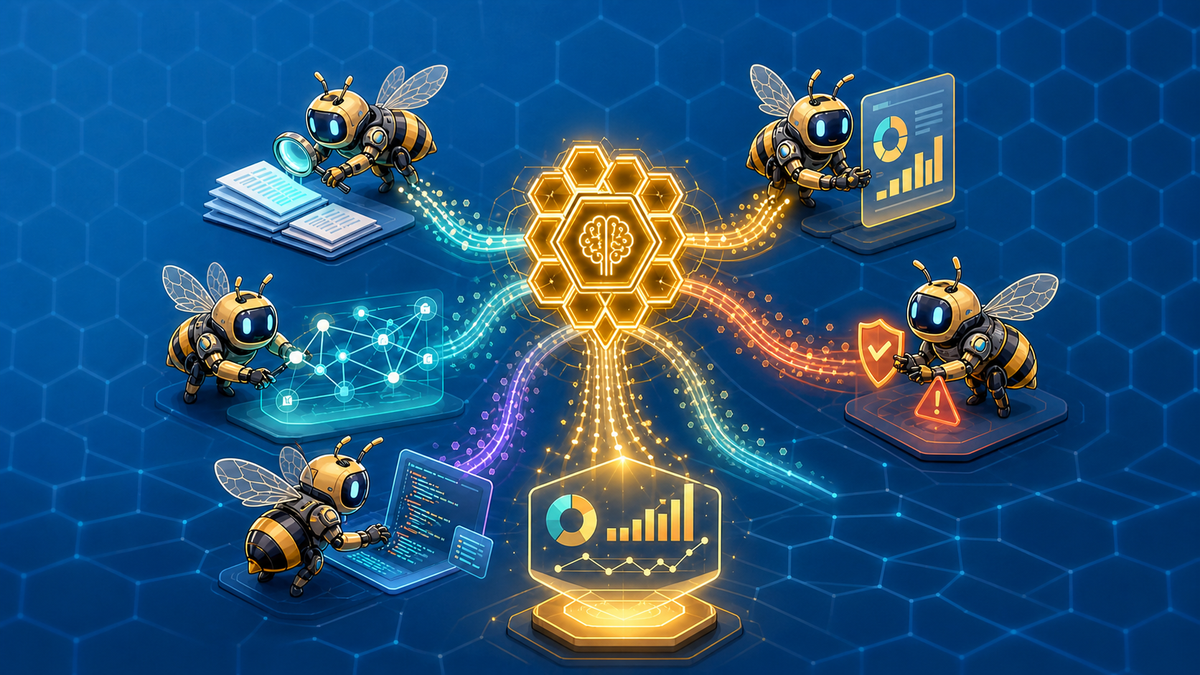
Swarm AI is becoming a prominent term in AI marketing, often presented as a meaningful advance over a single model. It is less clear whether the architecture deserves the attention its name attracts. Kimi can divide a single prompt among hundreds of AI agents, while security vendors such as 7AI describe groups of agents investigating alerts as a swarm. The term suggests that autonomous participants combine their perspectives into a form of collective intelligence, but most current implementations work differently from traditional swarm systems. They use a central orchestrator to divide work, assign specialized tasks, and recombine partial results. This architecture can create real advantages, but those advantages come from parallelizable work, useful differences among agents, and reliable synthesis. They do not come simply from increasing the number of agents. Understanding whether swarm AI represents an important technical advantage therefore begins with understanding what these systems actually do.
The original idea behind swarm technology comes from systems found in nature, for example ant colonies. No individual member has a complete view of the larger objective, and no central participant directs every action. Instead, many relatively simple participants follow local rules, respond to their environment, and communicate through limited signals. An ant colony can locate and exploit a food source even though no individual ant understands the colony’s complete search strategy. Intelligence appears at the group level because the participants coordinate well enough to accomplish something greater than any participant could accomplish alone. This combination of distributed work, limited communication, and collective results is the foundation of traditional swarm intelligence.
Kimi
Kimi provides a useful example of how the meaning of swarm has changed in the current AI market. Developed by the Chinese company Moonshot AI, Kimi has promoted its Agent Swarm approach alongside performance comparisons with frontier models such as Fable 5. These are not equivalent categories. Fable 5 is a language model, while Kimi’s Agent Swarm is an execution architecture built around a model. The comparison can make swarm appear to be an alternative kind of intelligence when it is more accurately a different way of organizing and allocating model inference.
Kimi’s architecture retains a central orchestrator, whose subagents can work simultaneously on different tasks. This preserves the distributed-work characteristic associated with swarm intelligence, but it abandons another defining characteristic: decentralized control. The workers do not organize themselves through local interactions as ants or bees do. A central model constructs the organization and supervises the work. Kimi’s Agent Swarm is therefore better understood as dynamic parallel orchestration. That distinction matters when evaluating where its benefits come from.
If Kimi’s agents are not equal members of a traditional swarm, their value must come from the differences created among them. Sending the same prompt, evidence, tools, and instructions to a thousand copies of the same model would produce some variation, but most of it could also be created through repeated sampling or changes in temperature. The answers would remain highly correlated because the agents share the same training and blind spots. Kimi’s orchestrator must create more meaningful variation. It can assign different portions of the work, provide different contexts, direct agents toward different sources, or ask them to approach the objective from different perspectives. Multiplying agents is not the important act. Designing useful differences among them is.
Those differences make recombination more difficult. In a conventional MapReduce operation, workers generally perform the same operation on separate partitions of comparable data, allowing their outputs to be combined through a known reduction step. Kimi’s agents may instead perform different kinds of work and return findings with different meanings. A research agent, a fact-checking agent, and a coding agent are not casting equal votes or producing interchangeable records. The orchestrator must remember why each task was created, what context the agent received, and how its result contributes to the original objective. It cannot simply count answers or concatenate summaries. The same component that divides the work must retain enough of the overall context to understand how the pieces fit together.
Producing a better answer does not necessarily mean producing a more efficient answer. Anthropic found that token usage alone explained 80 percent of the performance variation in its BrowseComp evaluations. Its multi-agent research system used approximately 15 times as many tokens as an ordinary chat interaction. The system performed better partly because it spent more tokens exploring the problem. Kimi’s swarm may benefit from the same effect. More agents can search more sources, follow more paths, and perform more analysis, but every additional worker requires additional model inference, tool use, and coordination.
This makes price per token a poor measure of the swarm’s economics. Even if Kimi tokens cost half or one-third as much as those of a competing model, a swarm that consumes several times as many tokens may cost more to complete the task. It may deliver a better result or finish sooner because that additional inference runs in parallel, but neither outcome makes the extra computation disappear. Swarm technology exchanges more total work for greater coverage and lower elapsed time. The relevant question is not whether Kimi offers cheaper tokens, but how much it costs to produce a completed answer of comparable quality. In this architecture, better performance may come less from a new form of collective intelligence than from giving the system a much larger inference budget.
The verdict on Kimi’s approach is still developing. Its results suggest that orchestration can improve the performance of a model that may trail stronger frontier models on some individual tasks. Dividing a large objective among multiple agents gives the system more opportunities to search, reason, and verify before the orchestrator produces the final answer. It also demonstrates that model capability and system architecture are separate performance levers. A stronger model might improve the same swarm, but that cannot be assumed without evaluation. Different models may decompose tasks, use tools, manage context, and reconcile findings in different ways.
What Kimi does demonstrate is that multiple agents can outperform one agent when the work contains genuinely independent parts. Financial research can proceed separately from workforce research because most of the evidence in one area is not required to interpret evidence in the other. Each agent receives a smaller context containing a higher proportion of relevant information, while the orchestrator preserves the larger objective and combines the results. The benefit comes from reducing irrelevant context, expanding search coverage, and allowing independent work to proceed simultaneously. That is a meaningful architectural advantage, even if its economics and performance depend on the task. Kimi’s results make a credible case for parallel orchestration, but they do not establish that every complex problem benefits from a swarm or that adding more agents is automatically better.
7AI and Swarm in SOC Investigations
This distinction becomes more consequential when swarm language moves from general research into security operations. 7AI describes swarming agents that review alerts, gather evidence, and conduct investigations, presenting the approach as an improvement over traditional workflow automation. That claim must hold across different detections, data sources, customers, and attack patterns. The relevant comparison is not between one successful swarm and one rigid workflow. It is between parallel agent orchestration and a mature investigation process operating repeatedly under production conditions.
Although 7AI does not publicly expose every detail of its architecture, its advantage is unlikely to come from asking identical agents to repeat the same investigation and then counting their answers. A more plausible design assigns parts of the investigation to agents focused on identity, endpoint, network, cloud, and threat intelligence. A coordinating agent then combines those findings into an overall case. This resembles a MapReduce pattern across security domains more than a traditional swarm of equal participants.
The important question is whether those agents should operate in sequence or in parallel. A sequential workflow encodes assumptions about dependency. It decides which analysis must occur first, what information the next agent will need, and how earlier findings should be compressed and passed forward. This preserves continuity when one step genuinely depends on another, but it also creates path dependency. An early error or omitted detail can shape every analysis that follows, producing agreement that is inherited rather than independently supported.
When investigative branches do not depend on one another, the directed acyclic graph can be flattened and executed in parallel. Each agent receives a smaller context containing information relevant to its specialty, while the orchestrator later receives findings from across the investigation. This reduces elapsed time and avoids deciding too early which evidence will matter. It also allows contradictory facts from one branch to expose errors in another rather than allowing those errors to propagate through the workflow.
Fluency has observed this difference in practice. Earlier approaches moved investigative work through a defined sequence, while later techniques allowed separate analyses to proceed independently before combining their results. The flatter structure has produced better results because local contexts remain focused and the final decision can draw from a broader set of independently collected evidence. Some discoveries will still require targeted follow-up, but those dependencies can be introduced after the initial evidence has been assembled.
This is not traditional swarm intelligence. It is structured parallel processing with specialized workers and a context-aware reduction step. Its advantage comes from improving both sides of the context problem. Each agent sees less irrelevant information, while the orchestrator receives a broader view before deciding what the evidence means.
What to Take Away
What is being marketed as swarm AI is not primarily about making many agents vote on the same answer. It is about dividing a problem so that each agent can work within a smaller, more relevant context, then combining those partial findings into a broader conclusion. The advantage comes from distributing attention and delaying assumptions, not simply from multiplying agents.
This architecture can improve on traditional workflow automation. A workflow defines dependencies in advance and passes a compressed interpretation from one step to the next. When those dependencies are wrong, early errors propagate through the investigation. Parallel analysis allows independent findings to emerge before the system decides how they relate. In security, that distinction matters because network, endpoint, identity, and cloud evidence may describe different parts of the same event rather than cast equal votes on a single verdict.
The improvement is not free. More agents consume more tokens, perform more searches, and create more findings that must be reconciled. The orchestrator must produce enough improvement in accuracy, coverage, or elapsed time to justify the additional inference. Price per token says little about that outcome. The more useful measure is the cost of reaching a complete and defensible answer.
The lasting innovation may therefore be neither the swarm nor its individual agents. It is the system’s ability to create useful divisions of work without requiring people to design every variation in advance. If an orchestrator can repeatedly determine what should be separated, what must remain connected, and how the resulting evidence should be recombined, this approach can move AI beyond imitating human workflows. If it cannot, swarm AI becomes a more expensive name for parallel processing.