
Kimi is Not K3
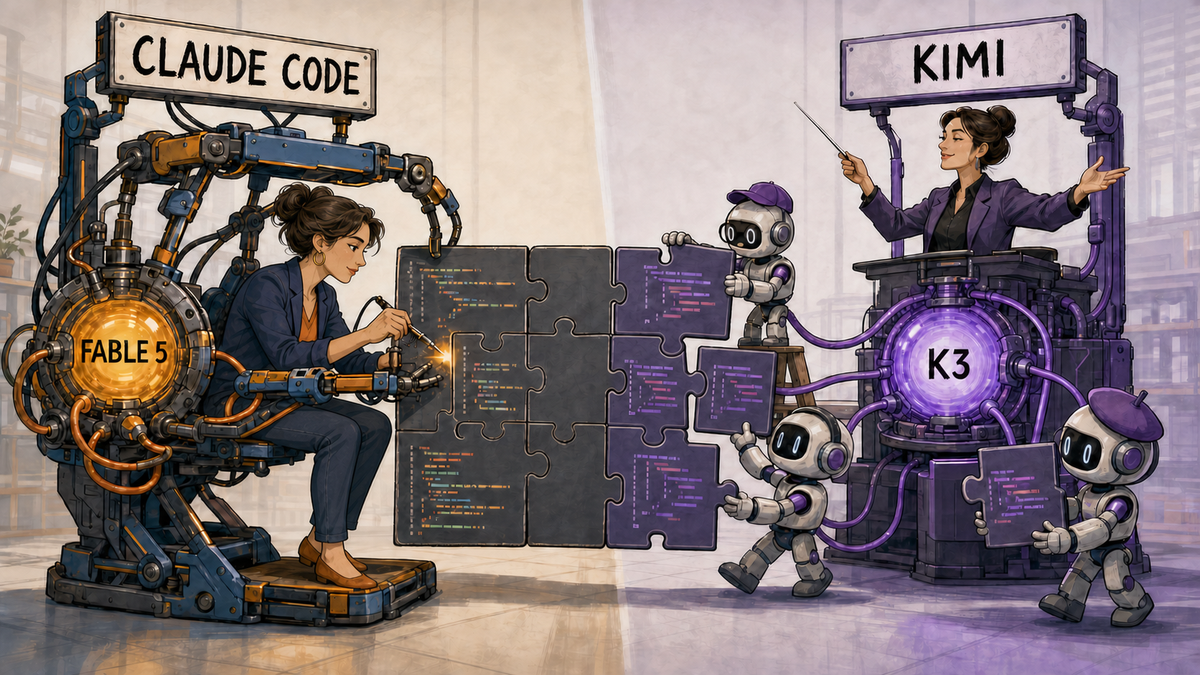
Articles comparing Kimi K3 with Claude Fable 5 often describe the result as Kimi competing with Claude. That comparison sounds reasonable because each name is associated with a company’s newest AI technology. It also combines two different layers of AI delivery.
Claude Fable 5 is a model that can operate inside Claude Code. Claude Code is the agentic system that provides the model with repository context, tools, permissions, execution, and feedback. The same distinction applies to Moonshot AI’s products. K3 is the model, while Kimi is the system that determines how model capability becomes completed work.
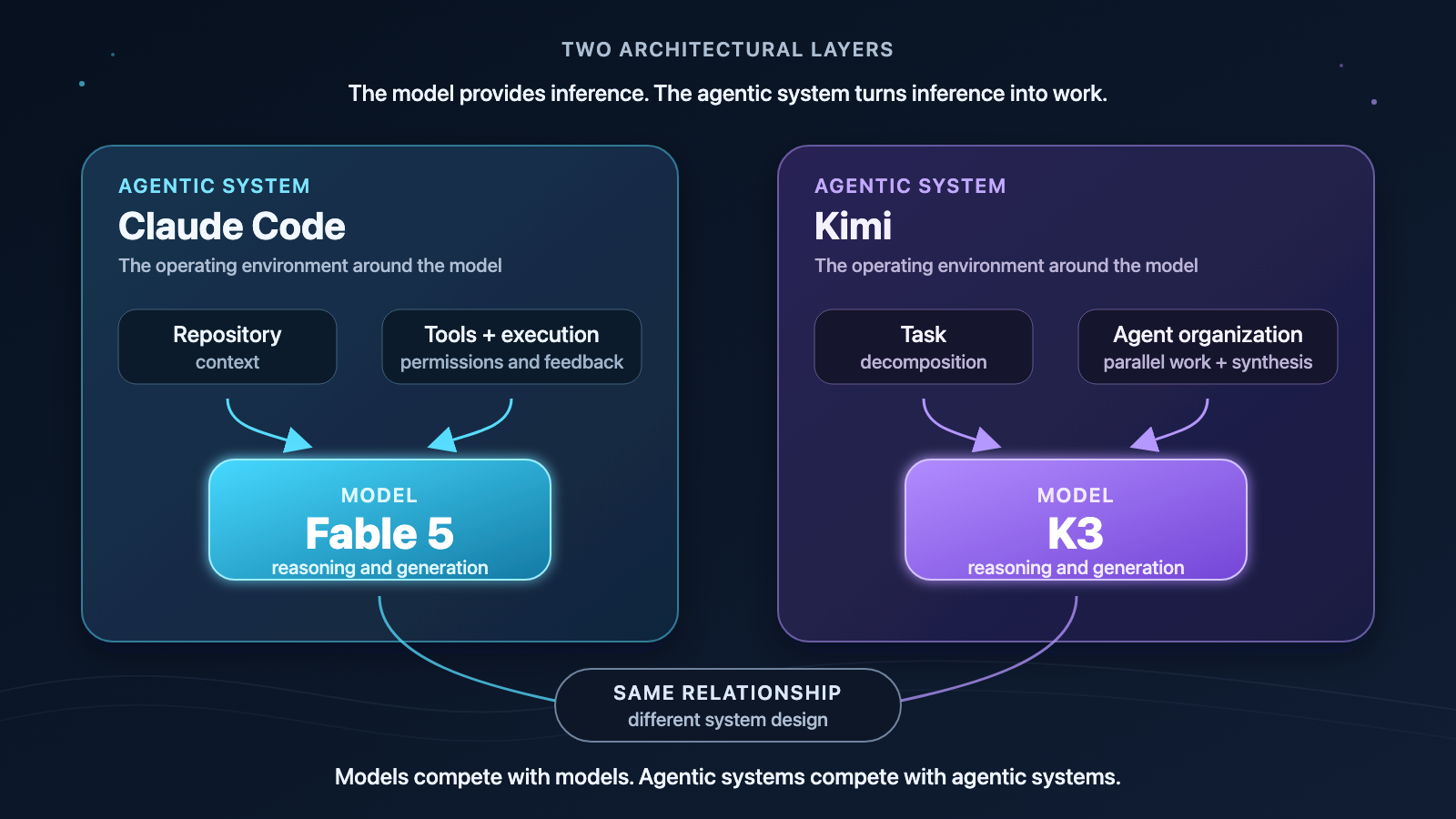
This is more than a naming distinction. Model capability and system capability are related, but they are not interchangeable. A stronger model can improve an agentic system, but the quality of the system also depends on how it selects context, divides work, invokes tools, handles failure, and verifies the result. Understanding what K3 contributes therefore begins with comparing it with Fable 5 as a model. Understanding what makes Kimi different requires a separate comparison at the system layer.
Why Kimi K3 Is Receiving So Much Attention
K3 attracted attention because its benchmark results placed it close to, and in some cases ahead of, Claude Fable 5. Coverage quickly translated those results into a broader claim that Kimi had beaten Claude. Reports that Microsoft was evaluating K3 for selected Copilot tasks reinforced the idea that Kimi had become a direct competitor to Anthropic’s products.
Both stories concern the value of K3 as a model. The benchmarks compare K3 with Fable 5, while Microsoft is reportedly considering whether K3 can perform work inside Microsoft’s existing system. Neither establishes that Kimi is a better agentic system than Claude Code. To understand what the comparisons demonstrate, we first have to compare the two models without treating them as the complete products in which they operate.
Comparing K3 With Fable 5
K3 and Fable 5 can be compared directly because both are models. Even at this layer, however, the result depends on what is measured and how the evaluation is performed.
Together AI’s DeepSWE testing found K3 and Fable 5 separated by roughly a single percentage point. Fable led when only the first attempt was counted, while K3 moved slightly ahead when each model received multiple attempts. The detailed results showed the same tradeoff: Fable was more consistent from one attempt to the next, while K3 benefited more from retries. The difference is too small and too dependent on the testing method to establish that either model is consistently better.
However, other testing disputes this. Interesting Engineering Reports the UK Artificial Intelligence Security Institute (UK AISI) and the US Center for AI Standards and Innovation (CAISI) found that Kimi K3 achieved an overall cyber capability score of 32.2%, compared to an average of 76.2% for top, unnamed US models.
Cost changes the decision again. Together AI reported a cost of $4.65 per K3 rollout compared with $13.41 for Fable 5 at its highest effort setting. K3 consequently produced 2.8 times more solved tasks per dollar in that evaluation. This is a substantial economic advantage for a system designed to generate and test several candidates. It does not establish that K3 is inherently more capable on an individual attempt.
K3’s lower price appears to create a clear economic advantage, but the price of one model call is not the cost of completing the work. As we discussed in the previous article on swarm AI, a model that costs roughly one-third as much can still become more expensive when the agentic system invokes it several times. Using Together AI’s reported rollout prices, five K3 attempts would cost $23.25, compared with $13.41 for one Fable 5 attempt. The relevant measure is therefore not cost per model call, but cost per completed and verified task.
The evaluation details also reveal why the model and system layers are difficult to separate. Moonshot evaluated K3 with the KimiCode harness on some benchmarks, while other models were evaluated through Claude Code, Codex, or other harnesses. On several tests, K3 and Fable were both placed inside the Claude Code harness. The published score may be labeled with the model’s name, but the observed result is produced by a model operating inside an execution system.
A benchmark remains useful when its conditions are understood. It becomes misleading when the system used to generate the result disappears from the interpretation.
From Model Capability to System Capability
Comparing K3 with Fable 5 tells us how the models perform under defined conditions. It does not tell us whether Kimi is a better agentic system than Claude Code or Codex. Answering that question requires moving from the component that produces inference to the system that organizes inference into work.
This distinction continues the argument from our earlier examination of swarm AI. A swarm does not become effective because several copies of a model produce answers. Its value depends on how the objective is decomposed, how context is distributed, how specialized work is coordinated, and how partial findings are reconstructed into a reliable result. Those responsibilities belong to the agentic system.
Comparing Kimi With Agent Harnesses
Claude Code and Codex make the system layer visible. Their underlying models provide reasoning, but the products do more than forward a prompt to an API. They inspect the working environment, select relevant context, expose tools, execute actions, return observations, maintain state, and provide a structure through which the model can continue working.
The harness determines how model capability reaches the environment. A model may know how to modify a repository, but the harness determines which files it sees, which commands it can execute, when approval is required, and whether the completed change is tested. The user experiences the result of that combined system, not the model in isolation.
Kimi also surrounds its model with an operating structure, but its distinguishing idea is the organization of work across agents. Kimi can divide an objective into specialized tasks, allocate separate contexts, perform work concurrently, and combine the contributions. What makes Kimi interesting is not simply that K3 generates strong answers. It is how the system allocates inference across a problem.
This is why substituting a model does not necessarily change the identity of the system. Microsoft could place K3 inside Copilot and still be operating Copilot. Microsoft’s context, tools, policies, interfaces, and orchestration would continue to determine how K3 is used. Microsoft would have adopted the model without adopting Kimi.
The reverse is also architecturally possible. Kimi could assign a task to Fable 5 when Fable’s reliability justified the higher cost and continue to operate as Kimi. Fable would supply inference inside Kimi’s organization of work. Kimi would not become Claude Code merely because one task was completed by an Anthropic model.
There is no public evidence that Kimi currently routes work to Fable 5, and the distinction does not depend on it doing so. The possibility shows where the identity of an agentic system resides. Kimi remains Kimi because of how it organizes work, just as Copilot remains Copilot when Microsoft changes the model assigned to a request.
The model can therefore become a routable resource. A system might use K3 when the task allows several inexpensive attempts and use Fable when first-attempt reliability is more valuable. A different task might benefit from another model entirely. Once the system can make that decision, the benchmark is no longer selecting one permanent winner. It is informing a routing policy.
The Comparison That Actually Matters
Kimi is not K3, just as Claude Code is not Fable 5. K3 and Fable can be compared as models, provided the benchmark conditions, retry policy, harness, and cost are included in the interpretation. Kimi and Claude Code must be evaluated as systems that turn model capability into work.
This changes the meaning of the current K3 attention. Its open weights, strong performance, and lower cost do not prove that Kimi has universally beaten Claude. They make K3 a more useful component for systems capable of choosing where and how inference should be applied. Microsoft’s reported evaluation of K3 is important for the same reason. It suggests that even major AI products may treat frontier models as selectable infrastructure rather than permanent identities.
The strength of a model is determined by what it can do. The strength of an agentic system is determined by whether it can choose the right capability, provide the right context, organize the work, and verify the result. Benchmarks can tell us something about the first question. They cannot answer the second by themselves.
K3 competes with Fable 5. Kimi competes through how it uses models. Once that distinction becomes clear, the question is no longer which model won the latest chart. The question is which system can convert the available models into completed, reliable, and economically defensible work.